
Loading.
reflections on the presentations of art.

I recently visited the Grand Palais Immersif on the day of the Paris Half Marathon.1 Surrounded by sweaty stragglers and the removal of race-day debris, I entered this unassuming doorway into a large, warehouse-like space. The plain walls and high ceilings were flooded with grand-scale projections of expressive text, bright colours, and moving imagery. Several vibrantly decorated trains rushed past me in either direction.
‘Loading. Urban Art in the Digital Age’ focuses on the world as a gallery, and the rise of street art during the twentieth century.2 I shan't dwell too much on the irony of charging for access to a project focused on art in public spaces, nevertheless, the collection exhibited pieces of street art from all over the world, over the course of the last century.
The vibrant colours and bold reclamation of wall space in cities across the world was a stark contrast to the pristine white-washing of Parisian architecture. Scored to a collection of Hip-Hop and R&B music, the projections immerse the viewer in a culture of anti-establishment creatives: reclaiming buildings, streets, and entire cities into their own creative playgrounds. The nature of the exhibit as a primarily 360° visuo-auditory projection is perhaps the largest extent to which the project approaches the significance of the ‘digital age’ and its link to urban art. However, this does create an undeniable question of how we choose to display, engage with, and experience art in the digital age.
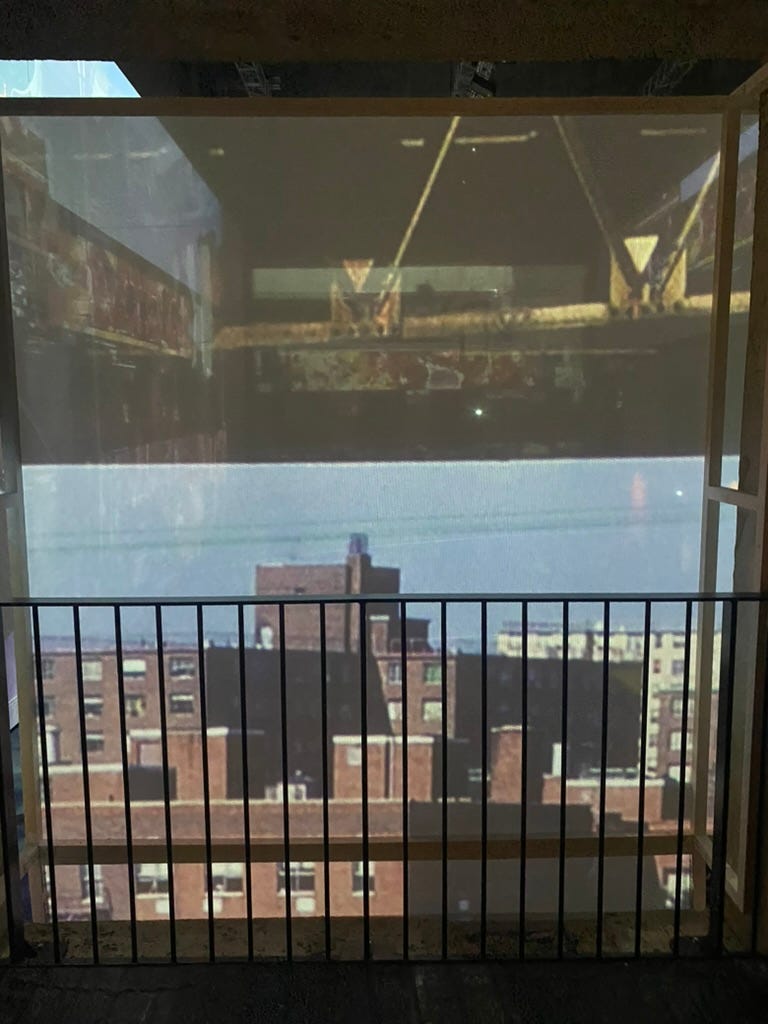
This is, of course, not the first projection-based exhibit of its kind. The first I remember seeing advertised was the Van Gogh Immersive Experience, which I saw predominantly through aesthetic shots on people’s instagram.3 Though I have yet to visit this exhibit, or achieve the photographs I see so effortlessly curated on my feed, I have seen smaller scale utilisations of the same technologies. London has even seen similar projection-based presentations of art and culture through Abba Voyage, and the BBC Earth Experience - both of which immerse the viewer in an experience of music and natural beauty, respectively, to create new interactions between the artist and viewer.4
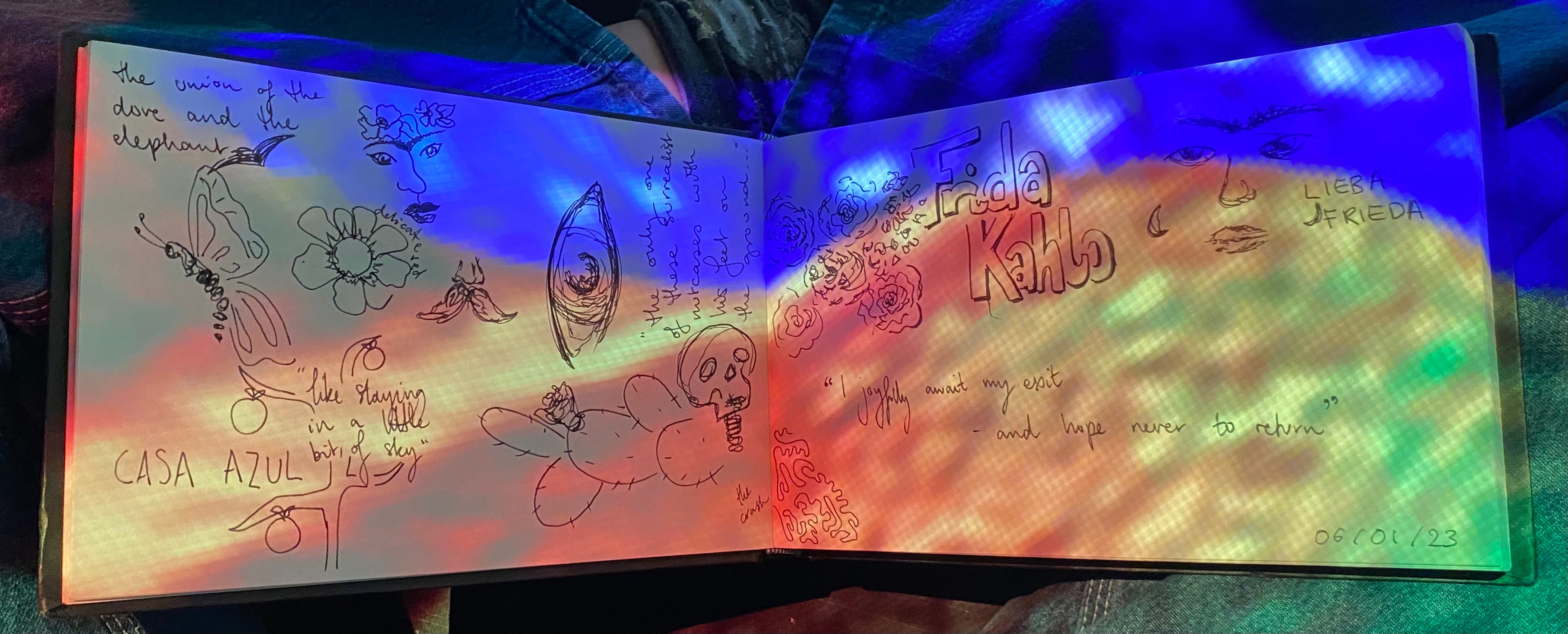
This notion in itself is a worthwhile investigation. It seems that the ways in which we, as a generation, engage with art is changing, though there are many that resent this shift. I often find that from certain creatives there is the sense that these ‘lightroom’ experiences are commercialised ‘cop-outs’ from the ‘real’ art - and in some ways I understand this argument. Experiencing Frida Kahlo’s work through an immersive, projection-experience in Coventry was in no-way comparable to visiting Casa Azul, and immersing oneself in the creative yet tragic space of her art.5 That being said, I have never visited Casa Azul. The Kahlo work I have seen has been displayed, rather dully, in a white-walled institution along with another 1000 pieces that one often feels pressured to admire equally. Now that is not to say that I don’t like the Pompidou Centre… however, to experience art in most galleries is an entirely different experience of art.6
The spatial experience of most museums and galleries, particularly larger, national and more traditional institutions, is one of a pristine, highly ordered, single-file type space. There are of course exceptions, and there are museums that do this exceedingly well. The Louis Vuitton Foundation, for one, embraces this pristine, clean-line aesthetic, to create a space that does not distract from the art.7 The high ceilings and vast rooms create the perfect space for larger pieces, and accommodate the large volumes of people viewing them. For artists like Mark Rothko, this enables the pieces to be viewed without distraction - though the high ceilings do not exactly fit with his desired presentation, I guess you can’t please everyone…8
But these manufactured spaces are an entirely different experience of art than the almost sensorially overwhelming projected spaces as used in the Grand Palais Immserif. That is not to say that one is superior to the other, though I don’t always find the traditional use of museum space entirely inspiring, but perhaps these two methods of art-appreciation can be mutually beneficial. For one, I am certain that experiences like the Loading. exhibition, not only engage new viewers, but also encourages the curation of artworks less traditionally approved of or academically engaged with.
The Loading. exposition redefines street art as a cultural phenomena worth engaging with on a creative and intellectual level. Looking at the increasing role of female graffiti artists and the socio-political contexts of these pieces, the exhibition redefines what many saw and continue to see, as ‘vandalism’. It also calls into question the ways in which we engage with art spaces, through public access to museum space and street space.
‘LOADING. L'ART URBAIN À L'ÈRE NUMÉRIQUE’ runs at the Grand Palais Immersif until 21st July 2024.
Upon editing this piece I realised that this was not in fact, quite so recent…
Loading. L’art urbain à l’ère numérique, 06.12.2023 - 21.07.2024, The Grand Palais Immersif, Paris.
Van Gogh Exhibition: The Immersive Experience, https://vangoghexpo.com/, worldwide.
Abba Voyage, https://abbavoyage.com/, London; BBC Earth Experience, https://bbcearthexperience.com/london/about, 01.03.2023 - 01.02.2024, London.
Life and Work of Frida Kahlo, 25.11.2022 to 29.01.2023, The Reel Store, Coventry, UK; Casa Azul: Museo Frida Kahlo, https://www.museofridakahlo.org.mx/, Mexico City.
The Frame, Frida Kahlo (1938), Centre Pompidou, Paris.
Fondation Louis Vuitton, https://www.fondationlouisvuitton.fr/en, Paris.
Mark Rothko, 18.10.2023 to 02.042024, Fondation Louis Vuitton, Paris.
Thanks for sharing. I think there will always be hierarchy in the art world and none less than in the displaying of art. For me- anything that engages viewers and encourages a diversity of art lovers is something to be encouraged !! X